Showing posts with label international schools. Show all posts

Sunday, 26 April 2015

Providing children with tools to tell their stories

My inspiration today is an amazing post by Eric Spreng, an international school teacher at the International School of Ouagadougou (the capital of Burkina Faso). I wish there were more international school teachers like him. I wish I had teachers like him when I grew up in Africa.

He teaches to promote student voice, he provides the students with tools they need to articulate themselves and their stories, especially when these stories challenge the dominate narratives that would marginalize them. I think this is what all children need but especiallt third culture kids. They need tools to articulate themselves. They need tools to be able to tell their story in what ever environment or situation they are.

Recently I came across this quote and I believe it is so true.

"All sorrows can be borne if you put them into a story or tell a story about them" these are words by Karen Blixen, the author of the book "Out of Africa".

Third culture kids grow up often moving from country to country with their parents. It can be very exciting and adventerous but the other side of the coin is that they often have to depart and leave friends and familiar places. They often have to say goodbyes. These moments can be painful and sad. If they are equipped with tools to tell their stories it could be great help for them in life. It will make them more resilient and more able to thrive in this global world.

Not only teachers can teach kids the importance of their stories, but we as parents can teach our
Photo by DrieCulturen, taken at Schiphol
children too. Decades of research has shown that most happy families communicate effectively. It means that as a family you tell a positive story about yourselves. If you want a happier family, create, refine and retell the story of your family's positive moments and your ability to bounce back from difficult ones. Read more on this topic in the article The Stories that Bind Us.

So back to Eric Spreng's post. He says: "From the beginning of the year, I make it clear that student voice is one of our great resources, that students' diverse experiences and cultures are assests to us as a community of learners. He gives examples of students that develop their own voice, do read his post called "Why I teach: Voice, Discourse and Empathy."

Related Posts

Friday, 6 April 2012

How do transitions effect children?

Recently the The American Foreign Service Association (AFSA) had a panel discussion about third culture kids and their experiences. You can watch the film, it is nearly one and a half hours full of good information. The members of the panel all have many years of experience working with Third culture kids. One of the members of the panel is International educator and adult third culture kid (ATCK), Rebecca Oden, M.Ed,  who has been a teacher and a coordinator providing academic and emotional/social support for transitioning families and students.  Her master’s thesis and research focused on transition and its consequent effect on the identity of TCKs in the international school setting.

I want to share something with you that Rebecca Oden said at the start of the panel discussion. I share these words with you because I believe they are true. According to Rebecca here are:

4 very important variables that influence the life of a third culture kid (or internationally mobile child):
  1. The developmental age of the child. There are different challenges and different issues at different ages. It's a little easier when children are younger, for example parents can arrange a play date and within moments of meeting each others toddlers can be playing together. The issues change depending on the developmental age. A child of 12 years old will not be charmed when mum arranges a play date but parents can facilitate the social interactions at that age.
  2. The number of transitions a child has faced. Parents often think: well they did fine the last move so all will be well this time. There are all kinds of reasons why this time the transition is more difficult. It could be connected with the developmental age. It could be transition fatigue, tried of all the change, the multiple loss of status, starting over time and time again. The fragmented identities that need to be put together time and time again.
  3. The family wellness. How is your family culture? Are you as parents doing well? Is this transition more difficult for one of the parents too?
  4. School choice.  Is it a school that is knowledgeable about these kind of issues? Does it have a program to address these issues?
I can not really remember how I experienced each transition in my youth. In Malawi I went to international schools but in Zimbabwe I attended good local schools. I have good memories at all of these schools. An international school is not automatically the best choice. What's your experience? Do you identify with these 4 variables?


 Related posts:

Thursday, 17 November 2011

Great Third Culture kid information on the Web

Every now and then I post twitter updates but recently I realized that not everyone is on twitter. I wasn't until a couple of months ago. In this post I wrote about my first adventures on twitter. You can follow me on twitter @DrieCulturen. Just today I read that the number of active twitter accounts in the Netherlands increased by 60% in the last 10 months. Well that's all for now about twitter, because I decided to give you links to good third culture kid information on the web. If you are a third culture kid looking for information or a parent raising children internationally do have a look at these sites.
  1. Libby Stephens wrote a great blog post on her favorite third culture kid resources. Libby Stephens is a cross- cultural transition consultant and she has worked with TCKs for more that 25 years. 
  2. Denizen online Magazine it's dedicated to TCKs. Interesting information: like an infographic about third culture kids.
  3. Educating Global Nomads a blog by Rebecca Grappo, a Certified Educational Planner. She is also mother of 3 grown expat children. On her blog you will find information about education, international schools, special needs and more.
  4. Multilingual Living is a place where parents raising children in more than one language and culture can find inspiration, tools, advice, wisdom and support! Worth a visit.
  5. In Culture Parent is a website for parents raising little global citizens. There's lots of different information there.
  6. MummyinProvence Ameena Falchetto is third culture kid and an expat living in France. She has lovely posts on her site about the Global Differences in Baby-making. Nice photos and advice from mothers who have been there before.
  7. Julia Simens she is author of the book "Emotional Resilience and the Expat Child", educator and consultant. She has a blog and here are her "Mustreads".
  8. Raising My TCKs it is an online community with personal stories about parenting third culture kids.
I hope you find what you are looking for. If you know of good sites, please let me know. If you need information about third culture kids but you can not find it, please let me know. Maybe I can help.

Saturday, 17 September 2011

Raising awareness about third culture kids: a brilliant idea.

Recently I stumbled on an interesting article in the Denizen online magazine. It is an interview with Alicia Ingruber (an ATCK) and the titel of the article is Sharing the TCK Experience through Design. I was impressed by the content of the article and even by the title.

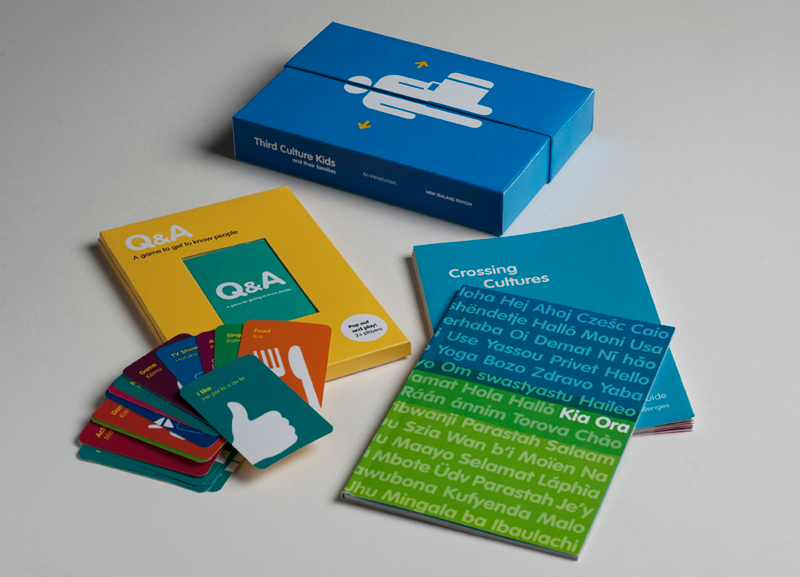
Alicia is an adult third culture kid, she was born in Australia, and lived in the Philippines, Canada, Cyprus and New Zealand. I was also excited to discover that she is partly Dutch too! At the age of 22, she discovered she was a third culture kid (TCK). She is a graphic designer and she created an information package for young TCKs moving to New Zealand.

There are 3 parts to the TCK information package:
  1. A children's book for 6 - 10 year olds. It is a story all about moving and going to a new school.
  2. A booklet for parents, with on one side the positive aspects and on the other side the negative aspects of being a third culture kid. It includes tips for parents.
  3. It is a card game: all about creating a sense of belonging. It is a conversation starter.


Alicia "We need to get more awareness out there. Being a TCK is something you should be proud of, and that there are so many people going through the same things you’re going through."  


I am excited about the information package. Is it not possible to make it an international project? A global information package available for parents, teachers, international schools, expats, companies etc? What do you think? Could it be possible? Do you have suggestions? Please let me know. Thanks.

Monday, 5 September 2011

Twitter update 5 september news about third culture kids

I want to share some good links with you. I twittered about these links the past few days.
Family fun!

10 Lifestyle habits of third culture kids http://bit.ly/nsQKSz written by Brian Royer

You might be a third culture kid: if you speak 2 languages, but can't spell in either...


interview with TCK who is president of a university in Paris: all about
&career

Bilingual babies' vocabulary linked to early brain differentiation: via

@Windmilltales Todays blog post Xpat Blog Hop - Hardest thing to adjust to..
5 tips for future to Holland!

life has another post. Hope you're liking them, community. Post by James R.Mitchner

Anyone got a hankering for sweet potato fries with garlic & Thai basil? lovely blog by and 4 !

'Should our kids go native too?' International vs. local schools, via Expatica. http://bit.ly/qBN36P

Expat Divorce. What about the kids?

J Simens.com New Post - World-wide childhood games teach valuable skills.
Read it now at http://bit.ly/oDfKW9

5 tips for surviving the worst roommate ever written by a graduate TCK

Wereldschool: Boekentip voor expats om kinderen voor te bereiden op vertrek: Anderland boeken. Biedt gespreksstof en handvatten.

Multicultureel opvoeden, ouders willen wel maar weten niet hoe..

Image thanks to Kakisky Morgue File